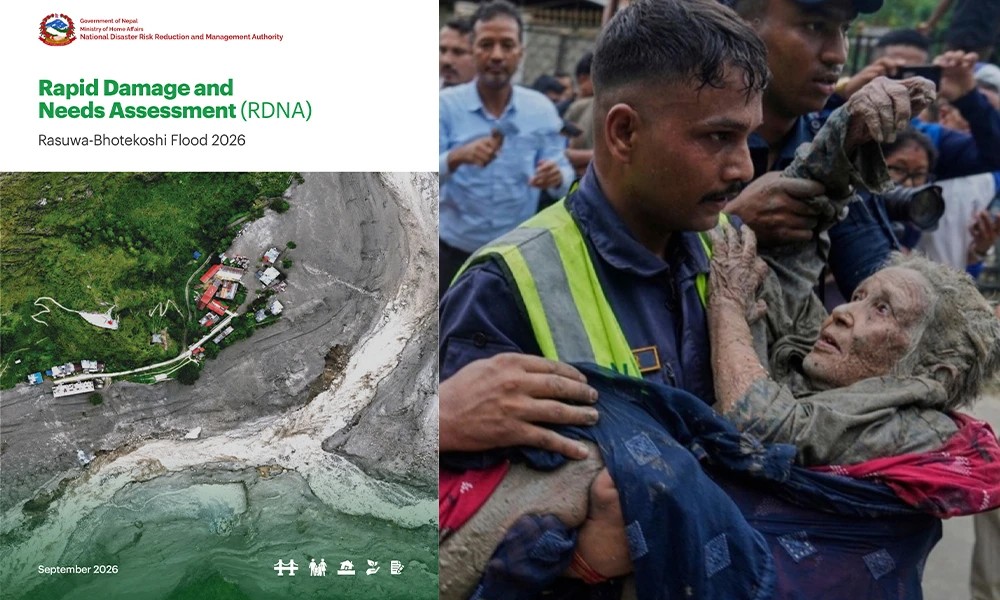

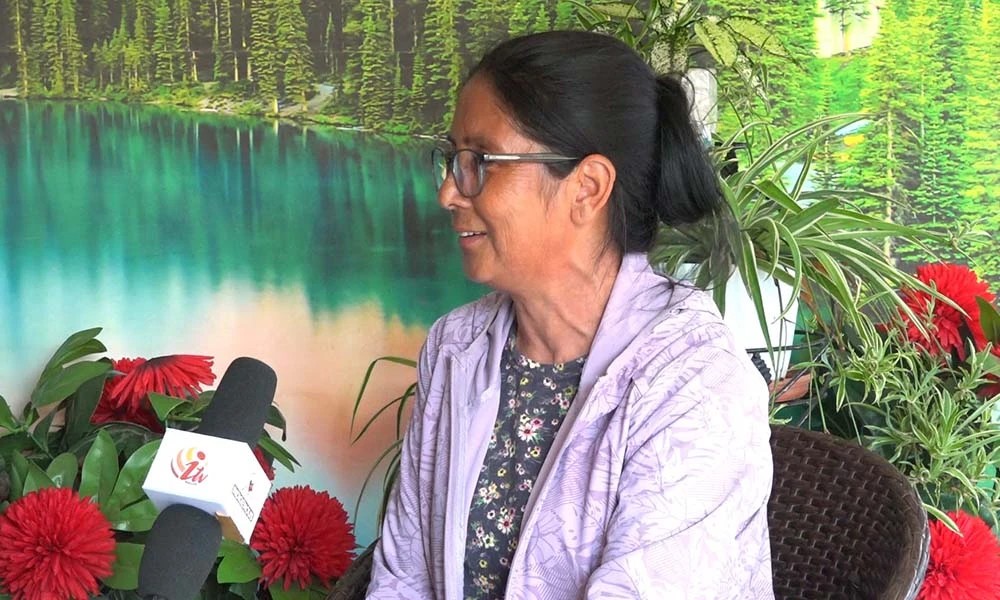
Fifty-four-year-old Palmo Dong of Syaphrubesi, Gosaikunda Rural Municipality-5 in Rasuwa, now finds herself living in a makeshift shelter inside the Gasok Monastery at Swayambhu, Kathmandu. She is not alone: around 547 displaced residents from Syaphrubesi are currently taking refuge here following catastrophic flooding along the Bhote Koshi and Trishuli rivers.
The flash flood that struck on Bhadra 10, 2083, erased Palmo’s home and life savings in a matter of minutes. Following the disaster, Nepal Army personnel rescued her and evacuated her to the capital.
For years, Palmo operated the well-known "Sky Hotel" in Syaphrubesi. Today, no trace of the lodge or neighboring structures remains. Her mother, father-in-law, and several neighbors were swept away by the raging torrent. Photos and videos circulating on social media show only a vast, boulder-strewn wasteland where her multi-story hotel once stood.
A Harrowing Escape
“I survived purely by luck,” Palmo recalled, recounting the trauma. “As we ran, I watched the flood drag my mother away right before my eyes. My second son and eldest brother saved me at the last second—they grabbed me by my hair from a ledge above and pulled me up. My father-in-law was standing near the path, and the roaring surge swept him away too.”
Palmo remembered a previous major flood in 2081 BS (2024) but noted how starkly different this event was.
“Back then, the water rose gradually, giving people enough time to run,” she explained. “We had time to pack our passports and cash, and we safely evacuated all the guests staying at the hotel. But this time, it was beyond imagination—it felt like an explosion. There was no time to save anything.”
“I survived purely by luck,” Palmo recalled, recounting the trauma.
Having spent her life in the high-altitude terrain of Rasuwa and having survived the devastating 2015 (2072 BS) earthquake, Palmo remarked that she had never witnessed a disaster of this scale or ferocity.
After fleeing up the steep slopes, the Nepal Army evacuated her to Dhunche, where she spent two nights. From Dhunche, survivors were airlifted by helicopter to Battar in Nuwakot before being transported by road to Kathmandu.
Chasing Opportunity along the Riverbank
Though originally from Goljung, Palmo relocated down to the riverbank market of Syaphrubesi decades ago, drawn by emerging commercial prospects.
“We cannot establish new lives in unfamiliar territory,” she emphasized.
“Syaphrubesi had grown into a thriving trading hub,” Palmo said. “It is the primary transit point to the northern border at Kerung—there is no other road network. It is also the gateway for trekkers heading into Langtang National Park. Travelers always stopped to spend a night or two in Syaphrubesi. Later, when the Chilime Hydropower Project began, the town buzzed with even more activity. We built our hotel to cater to that growing opportunity.”
Running the hotel allowed her to raise four sons, who are now grown and financially independent. Her husband currently manages business interests in Kathmandu.
A Plea to Return Home
Despite their losses, Palmo and other displaced residents are urging the government to help them return to their ancestral land rather than relocate them elsewhere.
While rebuilding directly along the riverbank is no longer viable, Palmo noted that many families own land on safer, higher ridges nearby.
“We cannot establish new lives in unfamiliar territory,” she emphasized. “We don’t know how to survive outside our native region. The people of Syaphrubesi belong to its climate, water, and soil; elsewhere, we are strangers.”
Survivors believe that once transport, electricity, and telecommunications links are restored to the valley, they can gradually rebuild their self-reliant livelihoods.
“We moved down to the riverbank in search of progress and development, but the river swept everything away,” Palmo reflected—a sentiment that captures both the historic ambitions of the mountain trading post and the heartbreak of a displaced community determined to reclaim its roots.