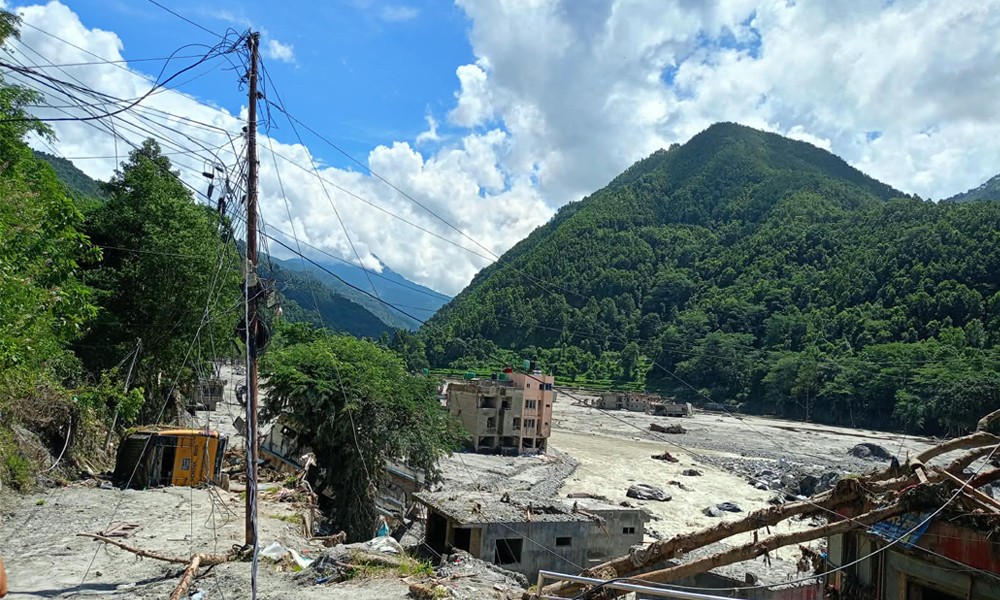


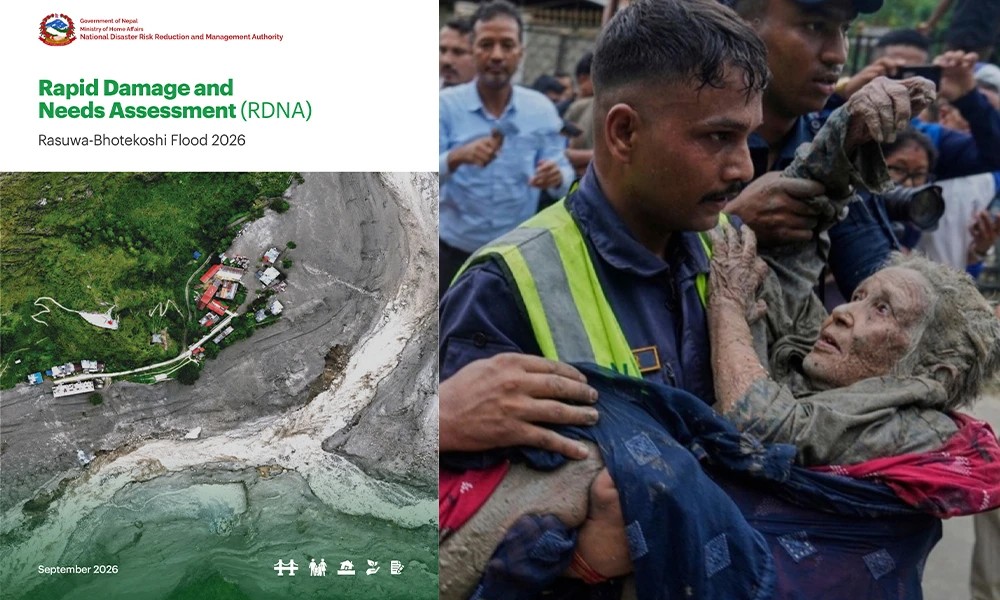
A technical team from the National Planning Commission and the National Disaster Risk Reduction and Management Authority (NDRRMA) has released the Rapid Damage and Needs Assessment Report regarding the destruction caused by the Bhotekoshi–Trishuli floods. The report estimates that NPR 723.31 billion will be required to reconstruct and recover affected infrastructure and sectors. It documents extensive devastation across Rasuwa, Nuwakot, Dhading, Gorkha, and Chitwan, noting that 7,570 private homes have been damaged, alongside 48 public buildings, 18 schools, seven health institutions, and 47 cultural heritage sites.
According to the assessment, the infrastructure sector suffered the heaviest toll, requiring an estimated NPR 473.57 billion for recovery alone. Among the hard-hit utilities, energy and transport sustained severe blows, with 13 hydropower projects totalling 759 MW and five solar plants totalling 24 MW impacted. In addition, 69 kilometres of road sections were damaged, while 33 motorable bridges were swept away and four others sustained partial damage. The productive sector—spanning trade, business, banking, and agriculture—is projected to need NPR 50.77 billion for restoration, after floods ravaged 1,806 hectares of cropland, 17 bank branches, and 4,800 commercial enterprises.
Indigenous Peoples' Concerns Sidelined in Technical Framework
While the report meticulously tallies physical destruction and monetary losses, it completely overlooks the fundamental rights and distinct needs of the communities native to Rasuwa, Nuwakot, and Dhading. By confining itself to a purely technical and monetary matrix, the assessment fails to recognize that the flood disaster unfolded on the ancestral lands of the indigenous Tamang people, who have inhabited these river basins historically.
Throughout the entire 103-page document, the terms "Indigenous Nationalities" or "Tamang community" are never mentioned. Even within the Gender, Equity, and Social Inclusion (GESI) section, the analysis is limited strictly to geographic indicators, disregarding the specific vulnerabilities of indigenous women and persons with disabilities.
Remarkably, throughout the entire 103-page document, the terms "Indigenous Nationalities" or "Tamang community" are never mentioned. Even within the Gender, Equity, and Social Inclusion (GESI) section, the analysis is limited strictly to geographic indicators, disregarding the specific vulnerabilities of indigenous women and persons with disabilities. Furthermore, the report makes an inadequate attempt to monetize intangible, cultural, and spiritual losses. In Section 4.1.5, titled "Cultural Heritage," damages are estimated at NPR 146.4 million, citing impacts on the historic treaty stone at Betrawati, temples, and cremation grounds. However, the report completely omits damage to Tamang sacred sites, including manes (Buddhist shrines), chortens, gumbas, and lha (shrines dedicated to local ancestral deities).
Treating these sacred spaces merely as damaged stone and soil is a grave conceptual failure. From an Indigenous Peoples' perspective, these sites are foundational to spiritual belief, ancestral bonds, ecological harmony, and cultural continuity; their destruction represents a direct assault on community history and identity. Ironically, even though modern assessment frameworks adopted by institutions like the World Bank and European agencies provide clear indicators for evaluating intangible cultural heritage and socio-cultural recovery, the authors have stripped this document of any indigenous sensitivity.
Flawed Relocation Plans and the Neglect of Customary Rights
The recommendations on relocating vulnerable settlements reveal even deeper shortcomings. For Indigenous Peoples, ancestral territory is not merely a plot of land for housing but the cornerstone of their language, faith, and collective survival. Relocation schemes must ensure cultural continuity and sustainable livelihood foundations; without such guarantees, the indigenous Tamang community faces displacement from ancestral lands and the imminent threat of cultural erasure.
Effective rehabilitation demands thorough, meaningful consultation with those affected. Under Articles 19 and 32 of the United Nations Declaration on the Rights of Indigenous Peoples (UNDRIP), securing Free, Prior, and Informed Consent (FPIC) is mandatory. Yet this principle was disregarded during the field assessments and surveys, and the report makes no provision for FPIC in its proposed resettlement plans.
Effective rehabilitation demands thorough, meaningful consultation with those affected. Under Articles 19 and 32 of the United Nations Declaration on the Rights of Indigenous Peoples (UNDRIP), securing Free, Prior, and Informed Consent (FPIC) is mandatory. Yet this principle was disregarded during the field assessments and surveys, and the report makes no provision for FPIC in its proposed resettlement plans.
Moreover, the assessment focuses exclusively on legally registered private holdings (Lalpurja), completely ignoring collective land tenure and customary rights. Because communal lands vital to indigenous lifeways fall outside formal cadastre registers, the report excludes them from damage calculations, virtually guaranteeing that the most vulnerable victims will be shut out of relief and compensation.
Similarly, the report neglects indigenous knowledge systems that have enabled Tamang communities for generations to navigate steep mountain slopes and forest ecosystems. It entirely disregards traditional early-warning signs, ecological stewardship, and community-level watershed management practices. Rather than relying solely on conventional engineering and concrete embankments, genuine recovery requires an integrated approach that incorporates indigenous environmental wisdom and nature-based solutions—underscoring the urgent need to rewrite the entire assessment report.