

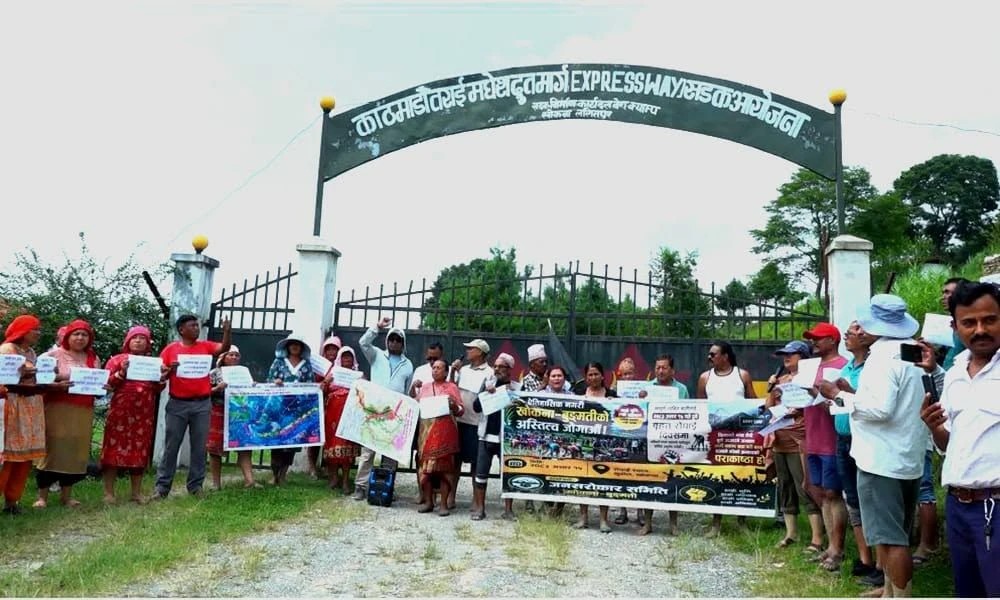
Indigenous Newar farmers from the historic settlements of Khokana and Bungamati staged a protest on the 15th of Asar (June 29), celebrated nationwide as National Paddy Day. Rallying under the banner "Save the Existence of Khokana and Bungamati," the agitation was organized by the Khokana Joint Stakeholder Committee. Instead of a traditional celebration, local farmers gathered in their fields holding placards, demanding the immediate withdrawal of the Nepali Army barracks from their territory and asserting their right to cultivate their ancestral lands.
The locals are fiercely resisting the Kathmandu-Terai Fast Track project, arguing that it will obliterate their cultural heritage, sacred religious routes, and customary lands. Naresh Maharjan, a resident impacted by the project, accused the Nepali Army of forcefully occupying their historic Guthi (trust) and Raikar (crown) lands. He emphasised that the intervention completely ignored international human rights treaties and took place without the Free, Prior, and Informed Consent (FPIC) of the Indigenous communities, despite repeated warnings regarding the lack of land ownership certificates for traditionally cultivated lands. Echoing this defiance, Kyo Kaji Maharjan, a senior citizen, stated that these lands have sustained their families for generations and vowed that the community would not surrender their soil, even at the cost of their lives.
Fast Track Dilemma and the Khokana Bottleneck
Managed by the Nepali Army, the Kathmandu-Terai Madhesh Fast Track is a 77.7-kilometre national pride project designed to link the capital with the southern plains. While it stands as one of Nepal's most critical infrastructure projects, its planned starting point in Khokana has become highly controversial. Construction there has stopped due to intense local opposition and unresolved land compensation disputes. This delay has raised serious doubts about the project's ability to meet its revised completion deadline of April 2027 (Baisakh 2084).
Residents argue that concentrating multiple mega-projects in one culturally sensitive area—including the Fast Track, Outer Ring Road, and Smart City initiative—would permanently destroy their archaeological heritage, religious pathways, and communal Guthi lands.
Khokana is more than an ordinary settlement; it is a living Newar heritage site of immense historical and cultural significance. Residents argue that concentrating multiple mega-projects in one culturally sensitive area—including the Fast Track, Outer Ring Road, and Smart City initiative—would permanently destroy their archaeological heritage, religious pathways, and communal Guthi lands. Many traditional farmers hold customary occupancy rights rather than formal land ownership certificates, which has delayed administrative processes. Locals have also consistently refused to accept government compensation. As a result, the government and the Nepali Army are reportedly preparing to amend the Detailed Project Report (DPR) by shifting the project’s starting point and toll plaza to Pharsidol in Lalitpur, approximately 3.3 kilometres away, as a workaround to the unresolved dispute.
Legal Deadlocks, Land Rights, and International Conventions
The impasse stems from the complex legal status of Guthi land, which covers a substantial portion of the Khokana and Bungamati regions. Under the current legal framework, the government has yet to establish a clear mechanism for determining how compensation should be divided between the tenant farmers, known as Mohi, who cultivate the land, and the Guthi Sansthan, the trust administration. Fearing the erosion of their historic and customary rights, farmers have refused to accept monetary compensation unless their long-term security is first guaranteed.
Indigenous Newar communities and human rights organisations have invoked international legal standards, particularly International Labour Organisation Convention No. 169 and the UN Declaration on the Rights of Indigenous Peoples (UNDRIP), to which Nepal is a party.
The issue is further complicated by the Land Acquisition Act of 1977, which requires official land ownership certificates, or Lalpurja, in order to claim compensation. Many Indigenous families in these areas have cultivated the land for generations on the basis of customary use rather than state-issued titles. As a result, they face serious technical and legal barriers that prevent the formal recognition of their claims and obstruct compensation-related transactions.
In response, Indigenous Newar communities and human rights organisations have invoked international legal standards, particularly International Labour Organisation Convention No. 169 and the UN Declaration on the Rights of Indigenous Peoples (UNDRIP), to which Nepal is a party. They argue that international law prohibits implementing large-scale development projects on Indigenous territories without Free, Prior, and Informed Consent (FPIC). Several lawsuits based on these claims are currently pending before the Supreme Court.
The Nepali Army has also acknowledged that the Khokana-Bungamati deadlock is not merely a technical matter but a deeper political and legal crisis. Project officials have repeatedly urged the civilian government, the Prime Minister’s Office, and the National Planning Commission to deliver a prompt political resolution, recognising that the military alone cannot address a systemic dispute rooted in land rights, customary tenure, and protections for Indigenous peoples.