

The catastrophic flood in the Bhotekoshi River has plunged the entire Tamang Indigenous community into profound grief. According to official government records, 1,259 deaths have been confirmed so far, while 5,053 individuals remain missing—the vast majority belonging to the Tamang Indigenous community.
The districts of Rasuwa, Nuwakot, and Dhading are ancestral land and territory of the Tamang Indigenous community, making this disaster an especially devastating blow to the community. While the tragedy is a national catastrophe that has affected people from all walks of life, including foreign nationals, it has struck the very roots of the Tamang homeland like a thunderbolt.
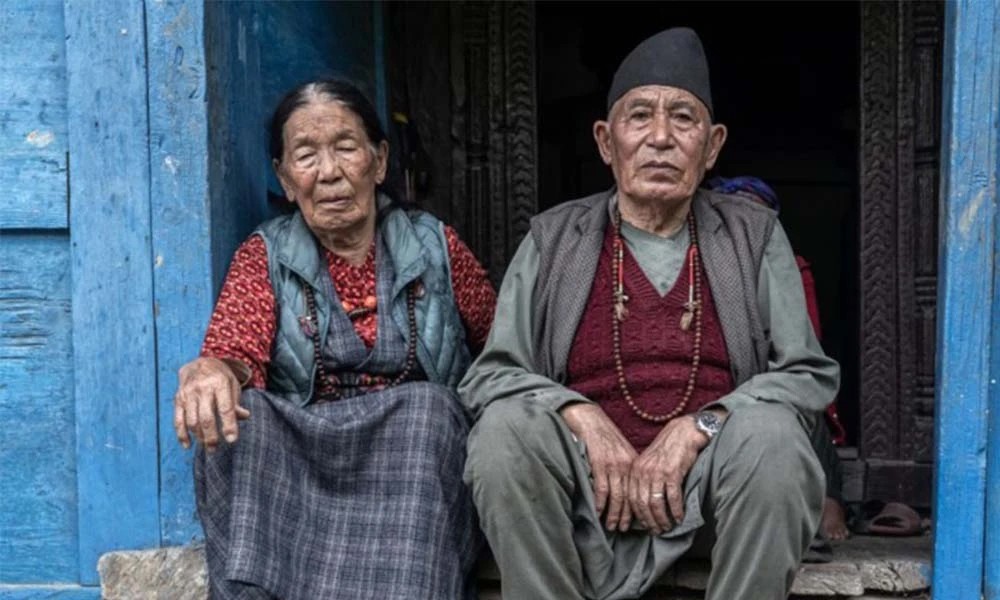
Among the severely affected is Dawa Finjo Tamang, the first person from the Tamang community to attain high-level state office. Born in Cholang Danda within the high Himalayan region of Gosaikunda, he once served as the first vice-chairman of the Rastriya Panchayat (the erstwhile national parliament).
Now aged 91, Dawa Finjo lives in Sano Bharkhu village, located in Gosaikunda Rural Municipality, Ward No. 5, Rasuwa. In recent days, media reports have captured him recounting his agonizing ordeal while simultaneously attempting to console neighbors and share in the collective sorrow of his shattered community.
A Heritage Swept Away in Moments
In Syabrubesi, Dawa’s son, Phurpatsang, operated the Buddha Guest Hotel. Built on ancestral land through four generations of relentless hard work, the thriving business had recently been handed over to Dawa’s grandson, Tindu Tshering.
Dawa Finjo had felt great pride in seeing his family rise from their modest ancestral home on the slopes of Bharkhu village above Syabru to running a multi-million-rupee hospitality venture. But on August 26, that hard-earned joy was erased forever.
Dawa Finjo and his wife survived solely because they had travelled to Bharkhu to stay for a week. Yet, surviving at nearly 100 years of age only to see three generations wiped out in an instant has left him in unspeakable anguish.
A violent surge swept down Bhotekoshi, devastating Syabru bazaar. The terrifying deluge claimed not just the landmark hotel but also Dawa’s son Phurpatsang, daughter-in-law Chhetin, grandson Tintu Tshering, granddaughter-in-law Yangji, great-grandson Kalsang, and a staff member. It played out like a waking nightmare.
Dawa Finjo and his wife survived solely because they had travelled to Bharkhu to stay for a week. Yet, surviving at nearly 100 years of age only to see three generations wiped out in an instant has left him in unspeakable anguish.
Two of his other sons—one living in the UK and the other in Australia—are preparing to return home to Nepal. The family has not yet broken the devastating news to his youngest great-grandson, who is studying in Kathmandu.
Warnings from the Past
Dawa Finjo Tamang chronicled his lifelong struggles and historic political journey in his autobiography, Bhedigoth Dekhi Rastriya Panchayatsamman (From Sheepfold to National Panchayat). While the book documents countless hardships, it contains nothing comparable to this level of destruction.
“I had heard stories from our elders about ‘Ghambal’—glacial floods that rise so high they overwhelm bridges from above. That is precisely what happened this time,” he recounted.
He recalled, however, ancient lore passed down by ancestral elders warning of catastrophic glacial lake outburst floods (GLOFs) that could sweep away entire bridges, roads, and settlements.
“I had heard stories from our elders about ‘Ghambal’—glacial floods that rise so high they overwhelm bridges from above. That is precisely what happened this time,” he recounted.
A Community Cut into Pieces
According to data from Gosaikunda Rural Municipality, Syaphru's population was 2,462, including 450 elderly residents. Authorities have not yet been able to compile even an initial estimate of how many survived.
Geographically, the flood has split Syabru into four isolated enclaves. Crossing between the banks of the roaring Bhotekoshi is entirely impossible. To make matters worse, the flood washed away the Bharkhu Khola bridge at the confluence near Syaphru bazaar, severing the settlement into two additional disconnected halves, leaving movement on foot impossible.
With road networks destroyed, bridges down, and telecommunications completely severed, even survivors within the same vicinity cannot reach or locate one another.
Most residents were engaged in the local hospitality trade, followed by transport labor and agriculture. Even among families cultivating the steep hillside terraced plots above Syaphru, household members typically worked in local hotels, transport services, or nearby hydropower projects. Those working across these three sectors bore the brunt of the deadly floodwaters.