
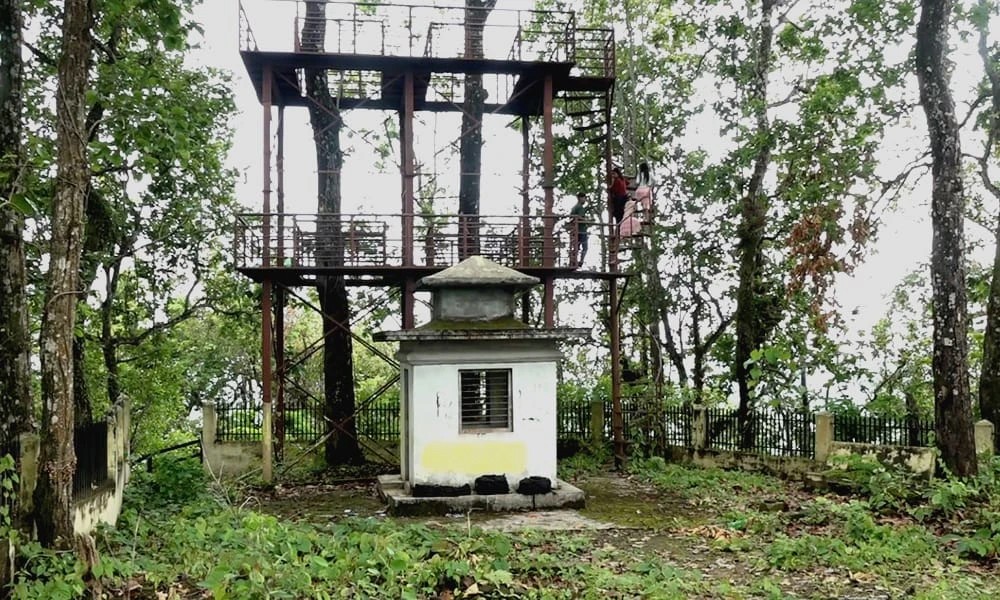
Local Indigenous Magar residents of Marin, Sindhuli, are preparing to formally reclaim the historic Thakur Darbar, also known as Thakur Palace, asserting that the site is part of their customary ancestral land.
The community maintains that Magars have lived in the region since the Malla era and believes the palace once belonged to their ancestor, King Thakur. However, archaeologists have yet to conduct formal excavations or publish definitive findings on the site’s origins.
Situated within a community forest in Ward No. 2 of Marin Rural Municipality, Thakur Darbar Hill lies approximately 2 km from Gardawa Chowk along the Madan Bhandari Highway. According to local oral history, the site was once the seat of a Magar king named Thakur.
Some historians have linked the site to King Harisingh Deva of Simraungadh, or possibly to his descendants. In 1381 BS, after the Sultan of Delhi, Ghiyasuddin Tughlaq, launched a devastating invasion of Simraungadh, Harisingh Deva fled toward the hills.
Historian S.K. Vidyalankar, in Modern History of Asia, notes that Harisingh Deva sought refuge in the hills and constructed a small fort. While this account is more commonly associated with the naming of nearby Hariharpur Gadhi, records indicate that after Palpa’s King Mukunda Sen captured Harisingh Deva’s newly declared state within a year, he fled farther east. Some local accounts speculate that he may have built a fortress in the dense forests of Gardawa in Marin, a site later known as Thakur Darbar.
According to resident Chul Bahadur Ale, folklore describes the king as having a regenerative power: if his head were severed, it could rejoin his body. The legend says that an invading army from Bhaktapur eventually beheaded him and carried away his head in a bag.
Local legends also attribute divine and supernatural powers to King Thakur. According to resident Chul Bahadur Ale, folklore describes the king as having a regenerative power: if his head were severed, it could rejoin his body. The legend says that an invading army from Bhaktapur eventually beheaded him and carried away his head in a bag. However, the head slipped out and rolled away. As dawn broke before the head and body could reunite, the king’s life came to an end.
The place in Marin where King Thakur is said to have been beheaded is still known as “Ghichrakateko Sthan,” or “The Place of Beheading.” It is marked by a half-length stone image. Locals say a corresponding stone believed to represent his head was once kept at Thakurthan in Ghattekhola, Rampur, but was stolen years ago.
Magar Connection to the Forts
Magar researchers note a strong correlation between historical forts, or Gadhi, and Magar settlements across the Inner Terai, from Udaipur to Makwanpur. Although the ancestral homelands of the Magar people are traditionally traced to the Bara Magarat and Athara Magarat regions—covering present-day Palpa, Gulmi, Baglung, Myagdi, Rolpa, and Rukum—their eastward expansion is closely linked to the Sen kings of Palpa and Makwanpur.
Magars held prominent military, security, and administrative positions, including the role of Mukhiya within the Sen army. As the Sen kingdom expanded eastward, Magar soldiers settled around strategic strongholds such as Makwanpur Gadhi, Hariharpur Gadhi, and Udaipur Gadhi.
Activists such as Rudra Bahadur Thapa Magar argue that this deep military and demographic connection supports the theory that King Thakur may have been a Magar ruler. Although “Thakur” is not a traditional Magar surname, Thapa Magar suggests that the title may have emerged through marriage, possibly evolving from Jwai Thakur—meaning “revered son-in-law”—after the king married a Magar daughter.
Threats of Modern Encroachment
The site’s archaeological significance is undeniable. Recent local construction has uncovered stone carvings of lions and tigers, wooden door frames, ancient bricks, and clay pottery. Local resident Balram Gurmachhan Magar has even kept a stone carving of a lion in his home for safekeeping.
“Several artefacts are lying neglected in the forest, and some have likely been stolen,” Balram said, stressing the urgent need for professional research, documentation, and preservation.
“Several artefacts are lying neglected in the forest, and some have likely been stolen,” Balram said, stressing the urgent need for professional research, documentation, and preservation.
Concern is growing among locals as the municipality has begun excavating the palace grounds to build modern infrastructure, including a view tower and a new temple. Activists warn that such interventions could permanently erase the site’s authentic historical and archaeological value.
Demand for Indigenous Ownership
The Magar community is actively campaigning for the right to manage and protect the palace grounds themselves. However, because the site currently lies within a designated Community Forest, administrative hurdles remain. Hiraman Gurmachhan, Ward Chairperson of Marin Rural Municipality–1, has committed to holding broad-based stakeholder discussions to map the area as customary Magar land.
Indigenous rights activist and advocate Dil Prasad Magar strongly supports the community’s demands, citing international legal frameworks. He noted that under the United Nations Declaration on the Rights of Indigenous Peoples and ILO Convention No. 169, Indigenous communities have the right to own, control, and manage their customary lands.
“An Indigenous community’s ancestral domain is deeply intertwined with its customs, traditions, and heritage,” Advocate Magar said. “The state must protect structures of such immense historical and archaeological value and hand over stewardship to the local Indigenous population.”
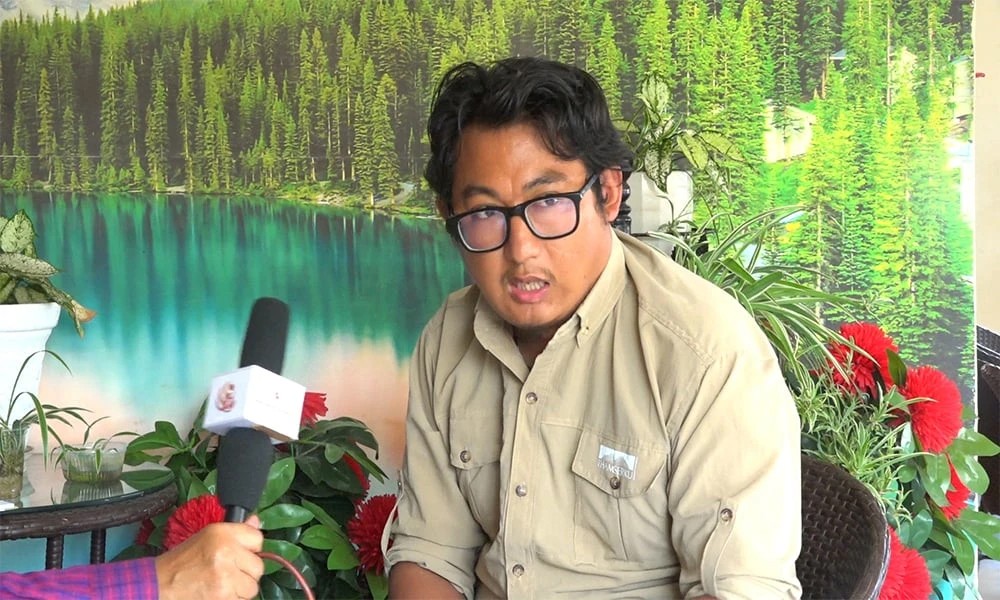
Jeevan Rana Magar of Marin–1 echoed this view, emphasizing that the folklore surrounding King Thakur exists exclusively within the Magar community. “Multiple communities live here now, but none of the others shares oral histories about Thakur Darbar,” he said. “This clearly indicates that the palace is directly tied to Magar heritage.”